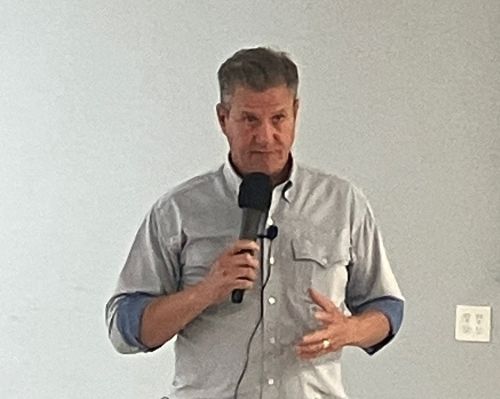
Throughout his remarks, Sheets framed many of Texas agriculture’s current challenges as the result of economic pressures that have increasingly burdened producers. He argued that rising production costs, declining profit margins, and an aging agricultural workforce are accelerating the loss of farms and ranches across the state.
Sheets contended that debates surrounding transmission line projects, renewable energy development, data centers, and other large-scale infrastructure initiatives ultimately reflect a deeper concern about the long-term viability of agriculture. According to his assessment, many landowners face difficult financial decisions as production costs continue to outpace revenues.
Citing conversations with farmers across Texas, Sheets described an industry confronting significant economic headwinds. He noted that producers today encounter substantially higher expenses for diesel fuel, fertilizer, seed, labor, and equipment while receiving comparatively lower returns for their commodities. The result, he argued, is a growing inability for many agricultural operations to remain financially sustainable and to transfer family farms to future generations.
A central theme of the candidate’s presentation was the need to strengthen market access for agricultural producers. Drawing from his experience building a national honey business, Sheets emphasized that government cannot directly control many production costs. Instead, he proposed focusing on initiatives that help farmers and ranchers expand market opportunities and receive greater value for their products.
He highlighted the importance of consumer-driven agricultural marketing, explaining how increased demand transformed the honey industry over the past decade. Sheets suggested that similar strategies could be applied across a wide range of agricultural sectors, including cotton, cattle, corn, peanuts, pecans, and specialty crops.
As part of that vision, he proposed a significant expansion of the state’s Go Texan program, transforming it from a branding initiative into a more comprehensive marketplace designed to connect Texas producers directly with consumers. Such an approach, he argued, could improve producer revenues while simultaneously increasing consumer access to locally grown and locally sourced products.
Sheets also devoted considerable attention to concerns about domestic food production and food security. He expressed concern over the nation’s increasing reliance on imported food products and argued that maintaining a strong agricultural base remains essential to ensuring a stable and reliable food supply.
In discussing agricultural sustainability, Sheets advocated for broader adoption of regenerative agricultural practices. He described regenerative farming as a system that emphasizes soil health, crop diversity, reduced tillage, and the integration of livestock into production systems. According to Sheets, these practices can improve soil quality, enhance water retention, increase nutrient density in foods, and contribute to long-term agricultural productivity.
Water conservation emerged as another significant topic during the presentation. Sheets argued that improving soil organic matter represents an important strategy for addressing Texas’ ongoing water challenges, noting that healthier soils are capable of retaining substantially greater amounts of moisture.
The candidate also explored the relationship between agriculture and public health. He maintained that farming practices influence nutritional outcomes and suggested that greater attention should be given to food quality as part of broader efforts to improve health indicators. In particular, he called for reforms to school nutrition programs and advocated for increased investment in facilities capable of preparing fresh meals for students.
Beyond agricultural policy, Sheets emphasized the cultural and economic significance of rural Texas. He argued that rural communities continue to serve as the foundation of the state’s agricultural economy and identity, while also expressing concern that many rural residents feel increasingly overlooked in public policy discussions.
According to Sheets, preserving Texas agriculture requires more than protecting farmland. It requires policies that strengthen economic opportunities for producers, promote food security, improve resource stewardship, and ensure that future generations can continue the state’s agricultural traditions.
The candidate concluded by encouraging civic engagement and voter participation while reaffirming his commitment to advocating for rural communities, agricultural producers, and policies that sustain the long-term vitality of Texas agriculture.
For Sheets, the future of Texas agriculture ultimately depends on restoring economic viability to farming and ranching operations, expanding market opportunities, and ensuring that rural communities remain an integral part of the state’s social, cultural, and economic landscape.